Evidence Explainer · Health & function
Why primary, secondary and subgroup trial results carry different weight
A result makes sense only beside the question fixed before the data, the people actually analyzed and the uncertainty around the estimate.
Published after three pre-prose research passes, a separate evidence review and a same-day source/status recheck.
Evidence at a glance
A reading method—not a treatment finding
- Evidence type
- Current methods guidance illustrated with two previously reported randomized trials
- Examples
- A four-week pectin pilot and the long-running ACTIVE cognitive-training study
- What this teaches
- Outcome hierarchy, multiplicity, interaction tests, analysis populations, uncertainty and replication
- What it does not do
- Recommend an intervention, rank studies or turn any secondary result into proof of benefit
The result needs its original question
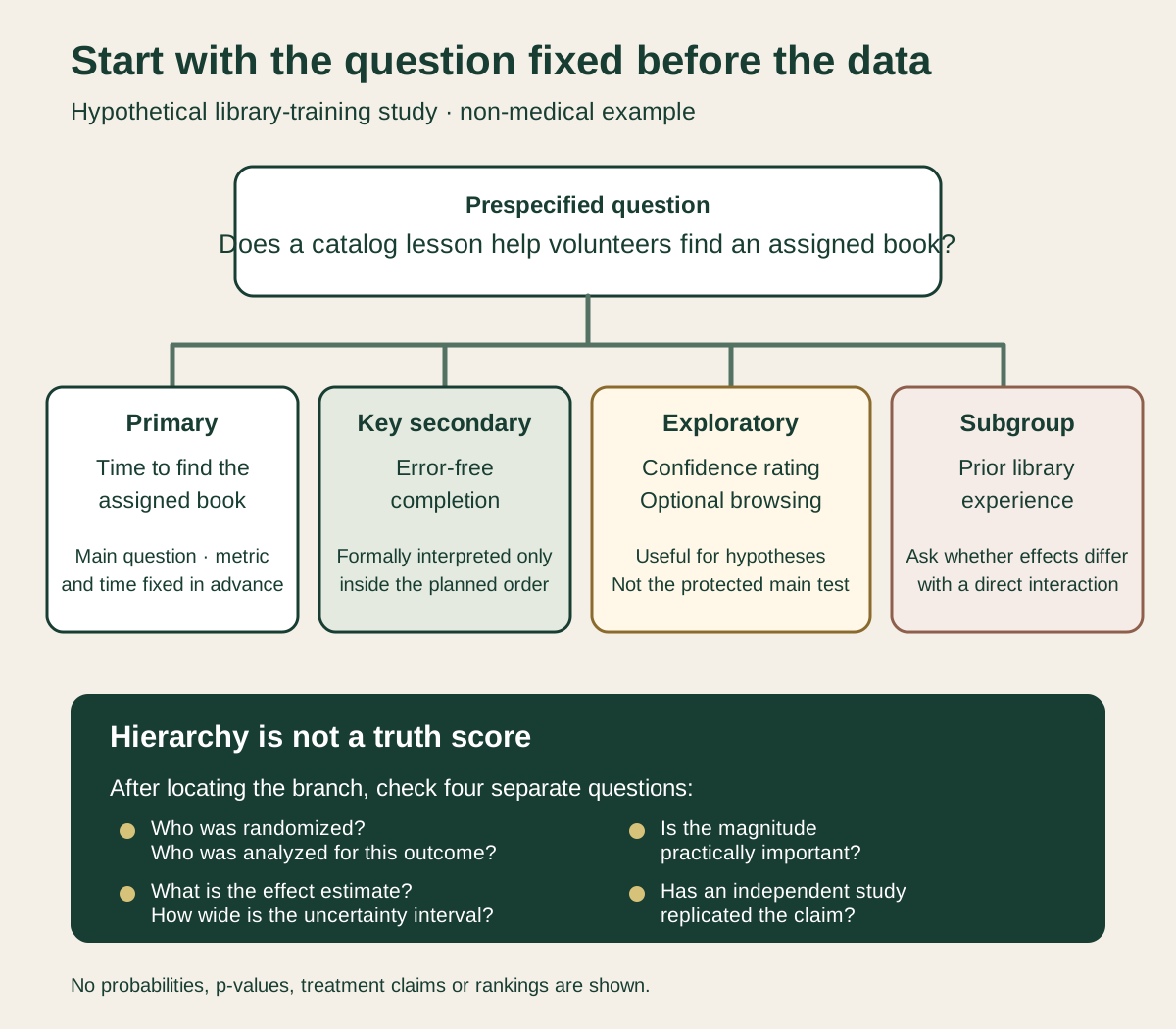
A trial can report dozens of measurements without asking dozens of equally important questions. The primary outcome is the prespecified measurement intended to answer the main question. Its full definition includes what was measured, how it was summarized and when. Secondary outcomes address additional questions; exploratory analyses can reveal patterns worth testing later. Those labels map the trial’s logic. They are not scores for whether a result is true.
That map matters because many comparisons create many opportunities for at least one chance-positive result. It also matters because the groups protected by randomization can change when an analysis selects participants after assignment. A careful reading therefore keeps outcome hierarchy, analysis population, effect size, uncertainty, practical importance and replication separate.
Start with what was fixed before results were known
Prespecification means the outcome, time point and analysis were fixed before the relevant results were known. CONSORT asks reports to define primary and secondary outcomes completely and explain changes from the protocol or registry. Prespecification improves interpretability, but it does not erase missing data, weak measurement, implementation problems or limited applicability.
The primary outcome usually carries the trial’s main inferential burden. A secondary outcome can still be important, but it does not automatically inherit the primary outcome’s status. A “key secondary” result supports a formal conclusion only when it sits inside the prespecified testing strategy—for example, an ordered hierarchy that protects later tests from being interpreted after an earlier gate fails. The label alone is not enough.
Exploratory does not mean false. It means the analysis usually generates or refines a hypothesis instead of carrying the same formal weight as a protected primary or key-secondary test. The constructive response is to ask what future study would test that pattern directly.
Count the opportunities for a striking result
Every additional endpoint, time point, subgroup or outcome definition creates another opportunity for a result to look unusual by chance. A prespecified multiplicity plan defines which comparisons belong to one inferential family and how they will be handled. There is no one correction that fits every trial, and no universal threshold turns uncertainty into certainty.
The number analyzed can also change by outcome. CONSORT asks reports to show the available-data denominator, group result, effect estimate and precision for each primary and secondary outcome. A headline randomized sample cannot silently replace the smaller set that contributed a particular measurement.
A subgroup needs a comparison between groups
A statistically significant result in one subgroup and a non-significant result in another does not establish that the treatment effect differs between them. The relevant question is a direct interaction or effect-modification comparison, reported with its uncertainty. A prespecified subgroup is generally easier to interpret than an undisclosed post hoc split, but prespecification does not remove low power or multiple-testing concerns.
This is why “worked in women but not men,” “worked in older but not younger participants,” or similar statements need more than two separate p-values. Look for the interaction estimate, the planned subgroup list, the number of participants and independent replication.
Randomization protects the comparison that was randomized
An intention-to-treat analysis asks about assignment to a strategy and preserves the groups created by randomization when all randomized participants are analyzed as assigned. A per-protocol or as-treated analysis asks a different question. A naive restriction to adherent participants can compare people who differ after randomization because adherence and later inclusion may relate to prognosis.
That does not make every per-protocol analysis invalid. It means the report must identify the question, estimator and assumptions. Likewise, “not statistically significant” in an ordinary superiority test does not prove that two strategies are identical, that the effect is zero or that a clinically important difference is impossible. Equivalence and non-inferiority require their own design, margin and analysis.
Example one: secondary signals do not replace null primary outcomes
In the pectin pilot, 31 community-dwelling adults older than 65 with frailty or pre-frailty were randomized for four weeks; 29 completed. The paper-defined primary outcomes were TNF-α, IFN-γ and zonulin, and the report found no significant between-group change in them. Its sample-size calculation used TNF-α evidence from a younger healthy-volunteer pilot; the study was not powered for each functional, psychological, quality-of-life or microbiome comparison.
The registry and paper also do not expose one stable outcome hierarchy: registered and published roles differ, the sequencing method changed, short-chain fatty acids were not quantified, and the first registry version was submitted after enrollment began. Selected sit-to-stand, HADS and SF-36 signals therefore cannot overwrite the paper-defined primary outcomes or establish broad clinical benefit.
One participant withdrew because of diarrhea and one without a stated reason; no serious adverse event was reported. Four weeks and 31 randomized participants cannot establish uncommon or durable safety. The report names NIHR Nottingham Biomedical Research Centre support and consulting, investigator-funding and advisory-board relationships. Those disclosures are context, not proof that a result is true or false.
Example two: identify which randomization protects which contrast
ACTIVE randomized 2,832 independent U.S. adults age 65–94 to memory, reasoning, speed-of-processing training or no-contact control. Booster sessions were offered to people who completed at least eight of ten initial sessions, and booster assignment within that eligible subset was randomized. A later claims analysis included 2,021 participants enrolled in traditional Medicare at baseline and also separated people by booster exposure or completion. The safe question is not “randomized or nonrandomized?” in the abstract, but which comparison each randomization protects.
The claims paper reported a hazard ratio of 0.75 (95% CI 0.59–0.95) for speed trainees who completed at least one booster and 1.01 (95% CI 0.81–1.27) for speed trainees without boosters; randomized-arm comparisons for memory and reasoning were null. Those numbers do not establish that generic brain games prevent dementia. They show why the analysis set, conditioning steps and exact contrast must travel with the result.
A published critique argues that the reported hazard ratios require multiplicity adjustment. The authors respond that the distinct training arms answered prespecified, mechanistically different questions and should not be pooled into one family. Neither paper makes the disagreement disappear. The claims analysis reports NIA and original ACTIVE NIH support; Karlene Ball disclosed consulting for, stock ownership in and a scientific-advisory-board role with Posit Science. The studied protocols cannot be replaced with a generic commercial-product claim.
A seven-question reading check
- What outcome, metric and time point were designated primary before results were known?
- Which secondary outcomes were inside an ordered or adjusted testing plan?
- Which analyses were exploratory or post hoc?
- Was a subgroup difference tested directly with an interaction?
- Who was randomized, who was analyzed and what happened after assignment?
- What do the effect estimate and uncertainty allow—and not allow—a reader to conclude?
- Has an independent study tested the same claim in a relevant population?
These questions do not rank studies or make a treatment decision. They provide one reusable method for keeping an attractive result from answering a broader question than the trial actually tested.
Primary and methods sources
- CONSORT 2025 Statement and Explanation and Elaboration
- FDA: Multiple Endpoints in Clinical Trials
- ICH E9(R1) and EMA multiplicity guidance
- Cochrane Handbook chapter 8 and chapter 10
- Pectin pilot, PMID 42803883 · DOI 10.1007/s11357-026-02562-8 · NCT06955975
- Original ACTIVE report, PMID 12425704 · DOI 10.1001/jama.288.18.2271 · NCT00298558
- ACTIVE claims analysis, PMID 41669119 · DOI 10.1002/trc2.70197
- Methodological critique, PMID 42339399 and authors’ response, PMID 42454025
Editorial state: Three research passes preceded prose, and a separate sentence-level evidence review covered all 32 frozen claims. Release-time source and status rechecks were completed November 12, 2026; registry histories were preserved without inferring changes where the live history was not extractable. AI disclosure: AI-assisted research and drafting. This page is educational and not medical advice.
Connected evidence
Explore more evidence on health and independence
Update history
- November 11, 2026 — discovery/scope, full-source/status/counterevidence/conflict review and frozen atomic mapping completed before prose.
- November 11, 2026 — separate evidence review found no unsupported proposition and required a bounded ACTIVE eligibility correction during integration.
- November 12, 2026 — same-day source/status recheck completed and the reviewed release candidate assembled for exact-head CI and rendered review.
Keep the question in view
More on the outcomes that shape healthy aging
See why selected secondary signals did not replace null paper-defined primary outcomes
A four-week pectin pilot found signals—not proof of frailty benefit
In 31 older adults with frailty or pre-frailty, low-methoxy pectin did not change the inflammatory outcomes the paper defined as primary. Secondary and exploratory signals remain preliminary.
Evidence scopeHuman frailty/pre-frailty · small randomized four-week nutrition pilot
Trace which ACTIVE randomization protects which comparison
Cognitive training improved practiced skills—not survival or proven dementia prevention
ACTIVE supports trained-ability gains and some function signals, found no mortality benefit, and leaves a claims-based dementia subgroup methodologically disputed.
Evidence scopeHuman trained abilities and long-term outcomes · randomized trial plus disputed secondary analysis